Private beta now open

AI made engineering abundant. FloFactor makes product judgment scalable.

FloFactor is the Product Factory for AI engineering teams.

Jira tracks work. GitHub stores code. Figma stores design. FloFactor stores product judgment.

It turns product context, customer feedback, roadmap goals, bugs, and codebase signals into prioritized opportunities, product specs, technical specs, and implementation-ready plans your team can trust.

Your AI dev team can build in minutes.

FloFactor helps you decide what is worth building before engineering starts.

In

Product context

CodebaseFeedbackBugsRoadmapGoals

Out

Build-ready work

Prioritized ideas
Product specs
Technical specs
Implementation plans

The founder story

I built FloFactor because I became the bottleneck.

AI changed how I build software.

With tools like Cursor, Claude Code, Codex, and agentic development systems, implementation was no longer the slowest part of the process. Once the work was clearly defined, AI could help ship production-grade features shockingly fast.

But getting to that point was still painfully manual.

Before implementation could begin, I had to decide what was worth building, validate the market angle, define the product behavior, shape the UX, think through the architecture, break the work into milestones, and review the AI development plan.

Read the origin story

The moment the bottleneck moved

The actual coding could take minutes.

The product judgment before coding could take days.

Coding got fast

Once the work was clearly defined, AI could help ship production-grade features shockingly fast.

Judgment stayed manual

Strategy, specs, UX, architecture, milestones, and review gates still had to be orchestrated by hand.

FloFactor became obvious

The bottleneck was turning expert product and technical judgment into something AI teams could safely execute.

Market shift

AI made building faster. It also exposed the real bottleneck.

For most of software history, engineering was the constraint.

Now, AI coding tools can generate, refactor, and implement software faster than most teams can decide what should be built. That creates a new problem.

AI reduced the cost of implementation. It did not reduce the cost of bad decisions. When implementation becomes abundant, product judgment becomes scarce.

The winning teams will not build the most software. They will build the right software. FloFactor improves decision quality before implementation begins.

Engineering got abundant

AI coding tools can generate, refactor, and implement software faster than most teams can define the right work.

Judgment got scarce

The scarce input is deciding what matters, how it should work, and what trade-offs are acceptable.

Questions moved upstream

Should we build this? Will users care? Is this the right feature now? How should it fit the architecture?

Bad decisions still cost

Every unnecessary feature creates review cost, maintenance cost, support cost, infrastructure cost, and technical debt.

What FloFactor actually does

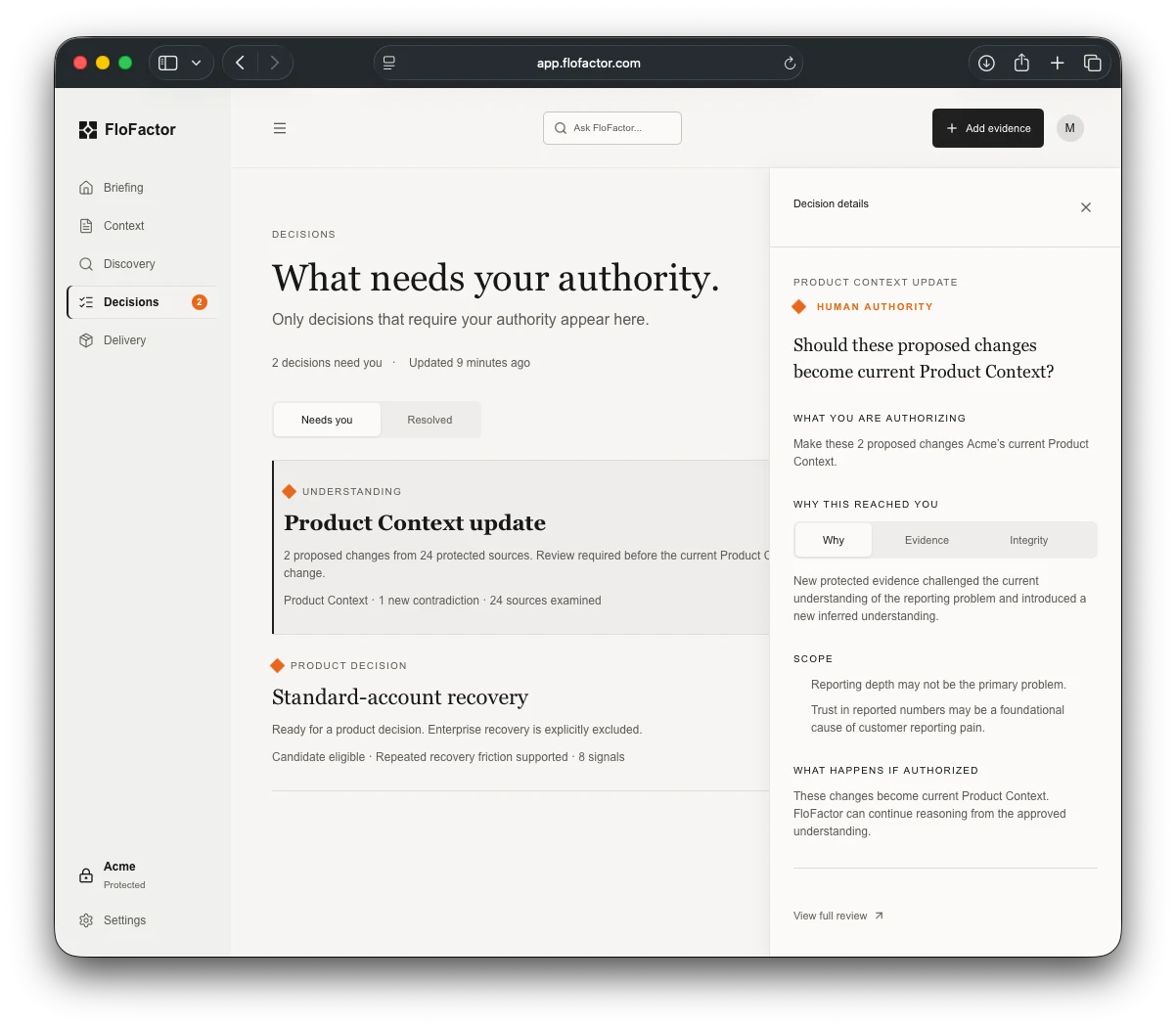
FloFactor turns scattered product signals into build-ready work.

It reads your product context, identifies what should be built next, scores each opportunity, and turns approved work into specs and plans your team can execute.

Step 1

Product context goes in

FloFactor reads your codebase, feedback, support tickets, bugs, roadmap, and business goals.

Step 2

Product opportunities come out

It identifies possible features, improvements, fixes, and product bets, then scores them by impact, effort, urgency, risk, and strategic fit.

Step 3

Build-ready specs are created

Approved ideas become product specs, technical specs, and implementation plans your engineers and AI coding tools can execute.

Your AI dev team can build in minutes. FloFactor helps decide what is worth building before engineering starts.

Example workflow

Product signals in. A governed, build-ready plan out.

Each step has a role, produces a required artifact, and must clear a review gate before work advances, so the output is something a senior engineer can trust.

Product context

  • Support tickets show repeated login issues.
  • The codebase already has accounts and email infrastructure.
  • Customer feedback mentions frustration with contacting support.

FloFactor-generated opportunity

"Let users reset their own password without contacting support."

  1. 1

    Score the opportunity

    Product strategist

    Scored 87, high impact, low effort. Tagged Build next.

    feature_brief.mdGate: Priority rationale required
  2. 2

    Create product spec

    Product spec writer

    Self-serve reset via email link. Reduces support tickets and unblocks locked-out users.

    product_spec.mdGate: Acceptance criteria, risks, edge cases & non-goals required
  3. 3

    Create technical spec

    Tech lead

    Reset-token table, expiry job, request + reset API routes, transactional email.

    technical_spec.mdGate: Must reference real repo files and architecture
  4. 4

    Create implementation plan

    Implementation planner

    Sequenced, testable tasks ready for engineers and AI coding tools.

    implementation_plan.mdGate: Every step needs files, tests, and validation

Ready for engineers and AI coding tools

Implementation ready

Where FloFactor fits

The Product Factory upstream of your AI coding tools.

Jira tracks work. GitHub stores code. Figma stores design.

FloFactor stores product judgment.

FloFactor is not another AI coding tool. Cursor, Claude Code, Codex, and similar tools make engineering faster. FloFactor gives them the product planning layer they need upstream.

Priorities, specs, review gates, and implementation-ready plans are created before code starts.

AI Coding Tools

Implementation layer

  • Answer: How do we build this?
  • Generate and edit code from prompts
  • Execute tasks once work is well-defined
  • Optimize implementation speed
  • Depend on clear direction before work starts

FloFactor

Product Factory layer

  • Answer: What should we build, why should we build it, and what needs to be true before engineering starts?
  • Captures product context, customer signals, priorities, constraints, and architecture
  • Creates product specs, technical specs, implementation plans, and review gates
  • Turns expert judgment into a reusable decision system
  • Makes product decision-making faster, clearer, and more repeatable

Who it is for

Built for the people who live between product and engineering.

Technical founders

You are no longer blocked by engineering. You are blocked by how fast you can turn your judgment into executable plans.

Product-minded engineers

Stop vibe-coding features. Turn product intent into production-grade implementation plans.

AI-native startups

When your AI team can build anything, FloFactor helps you decide what is actually worth building.

Technical PMs

Turn product strategy, user needs, edge cases, and technical constraints into specs engineers and AI tools can trust.

Private beta

Join the private beta

We're onboarding technical founders, product-minded engineers, and AI-native teams who want to build the right thing faster.

  • Early access to the Product Factory
  • Turn product signals into build-ready work
  • Help shape the Product Factory workflow
  • Work directly with the founding team